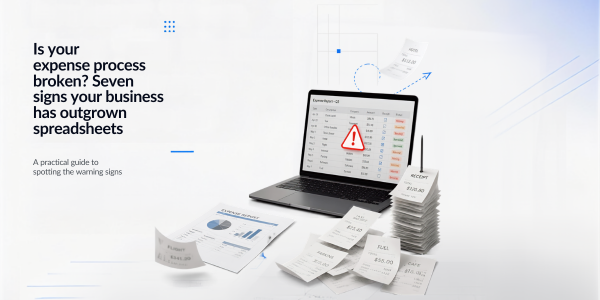
Artificial Intelligence (AI) is a concept that everyone is now familiar with. It’s undoubtedly transforming how individuals and companies approach their work. As we strive for efficiencies, AI in expense management is helping us to achieve them. As with the advance of any technology, there are pitfalls that companies need to be aware of. At Webexpenses, we’ve been monitoring the rise of fake receipts which can be used to submit fraudulent expense claims and commit expense fraud.
As CEO of Webexpenses, I want to share some insights into how this challenge is evolving-and more importantly-how we’re helping businesses stay one step ahead.
- Fake receipts and expense fraud in focus
- How easy is it to create fake receipts to commit expense fraud?
- How easy are fake receipts to detect?
- How can you combat fake receipts and expense fraud prevention?
- Company credit cards
- Receipt matching
- Put yourself in control with Webexpenses
Fake receipts and expense fraud in focus
Expense fraud is nothing new and affects every company where expenses are prevalent. Mileage calculations can be rounded up, taxi fares tweaked and duplicate receipts submitted. Manual processes leave expenses vulnerable to human error, making it difficult to guard against fraud.
So, too, is managing expense policies. Again, where manual processes are prevalent, it makes the task of tracking expense claims and their legitimacy harder.
We’ll look at how AI-powered expense management can combat fraud shortly. In an environment where fake receipts can be created by AI easily, expense fraud is becoming easier to commit and harder to detect.
How easy is it to create fake receipts to commit expense fraud?
The answer, worryingly, is very. You have likely heard or are familiar with ChatGPT. Its latest image generator makes the task simple. Where previously you’d have needed familiarity with advanced image editing tools and a lot of time, now you can add prompts to ChatGPT and it does the heavy lifting for you.
This exposes businesses to a more sophisticated level of fraud. It may not involve fake receipts, but rather manipulated ones. As seen with mileage and taxi fares, it takes little effort for someone to create a higher value receipt that closely resembles the original, such as for a client lunch.
This is where the greatest threat lies. It will be easier to detect fully fabricated AI-generated receipts simply by checking them against diaries. If they weren’t at client meetings at the time of the expense submission, it validates examining the claim further.
Where they were, however, and you know they took said client to said restaurant on that day, picking up on the expense fraud becomes far more difficult. Or does it?
How easy are fake receipts to detect?
At present, not very. That is not to say, however, that it’s impossible. Many of the examples online of AI-generated fake receipts are easy to spot. The harder ones to detect have had more time spent on them. So, if something doesn’t look right, always encourage your finance team to say so and ask for further information. This could be, for example, the line from their bank statement that corresponds with the expense in question.
Of course, that’s impossible to do for every expense claim that your finance team processes. As AI and fraud continue to evolve, companies need to be proactive.
How can you combat fake receipts and expense fraud prevention?
The good news is that there are approaches and technologies that you can adopt now. At Webexpenses, our expense management software is designed to make the process of expense management as efficient, accurate and expense fraud-proof as possible.
Company credit cards
Company credit cards detach the expense claim from the point at which expense fraud can be committed. With Webexpenses, you can automate the entire process from the point of spend to reconciliation. Since any spend on a company credit card comes from company accounts, fraudulent receipts are easy to pick up. It also renders them unnecessary to submit on the part of the employee.
Receipt matching
As part of automating your company credit card expenses, Webexpenses has an additional feature to auto-match receipts with Webexpenses. Employees simply take a picture of the receipt in Webexpenses, which then matches it to the correct company credit card expense. This eliminates fake receipts being submitted, as unmatched claims offer no benefit to the employee. This feature is one of the most effective tools in AI and fraud prevention.
Put yourself in control with Webexpenses
Whilst AI and expense fraud evolve, so does expense management software like Webexpenses. Stay ahead of the curve by taking control of your company’s expenses. Don’t leave your processes vulnerable to human error or fraud.
Discover how Webexpenses can support your fraud prevention strategy – with a free demo of our system.

Andrew May
CEO Webexpenses