A public product roadmap is a live, transparent view of what a software company is building, what is coming next, and what is on the longer-term horizon. We have just launched ours – and anyone can see it. You, your neighbour, that guy you sometimes see riding a unicycle in your local park. Everyone.
That transparency is a deliberate choice. Most software companies keep their roadmap internal. Priorities shift, features get quietly dropped, and customers are left guessing. That’s nifty for them because it spares potential embarrassment or awkwardness. Something doesn’t work? Just sweep it under the rug.
We think you deserve better than that. And so, we’ve published exactly what we are working on, in plain language, with no spin.
Publishing our roadmap is an extension of how we already operate. Our vs Payhawk comparison names a competitor directly, acknowledges their genuine strengths, and makes our case on the merits. The roadmap is the same instinct applied to product development: show your workings, let you make up your own mind.
So, I encourage you to check out our public roadmap. But before you get stuck in, I’d like to walk you through the roadmap, why we’ve built it the way we have and what it tells you about how we think about product development.
Why most vendors keep their roadmap hidden
If you’ve ever been told ‘that’s on our roadmap’ during a sales process and then never heard about it again, you’ll understand the problem.
Internal roadmaps protect vendors, not customers. They create room to quietly drop features, shift priorities without explanation, and make commitments that aren’t really commitments. The asymmetry works in their favour: you don’t know what they promised, so you can’t hold them to it.
A public roadmap eliminates that room. If something is on it, it’s real. If it changes, we have to tell you. That’s an exposure most companies are unwilling to accept – because it means being accountable not just for what you build, but for what you said you’d build.
We think that’s exactly the kind of accountability you should be able to expect from your software provider.
How the roadmap is structured
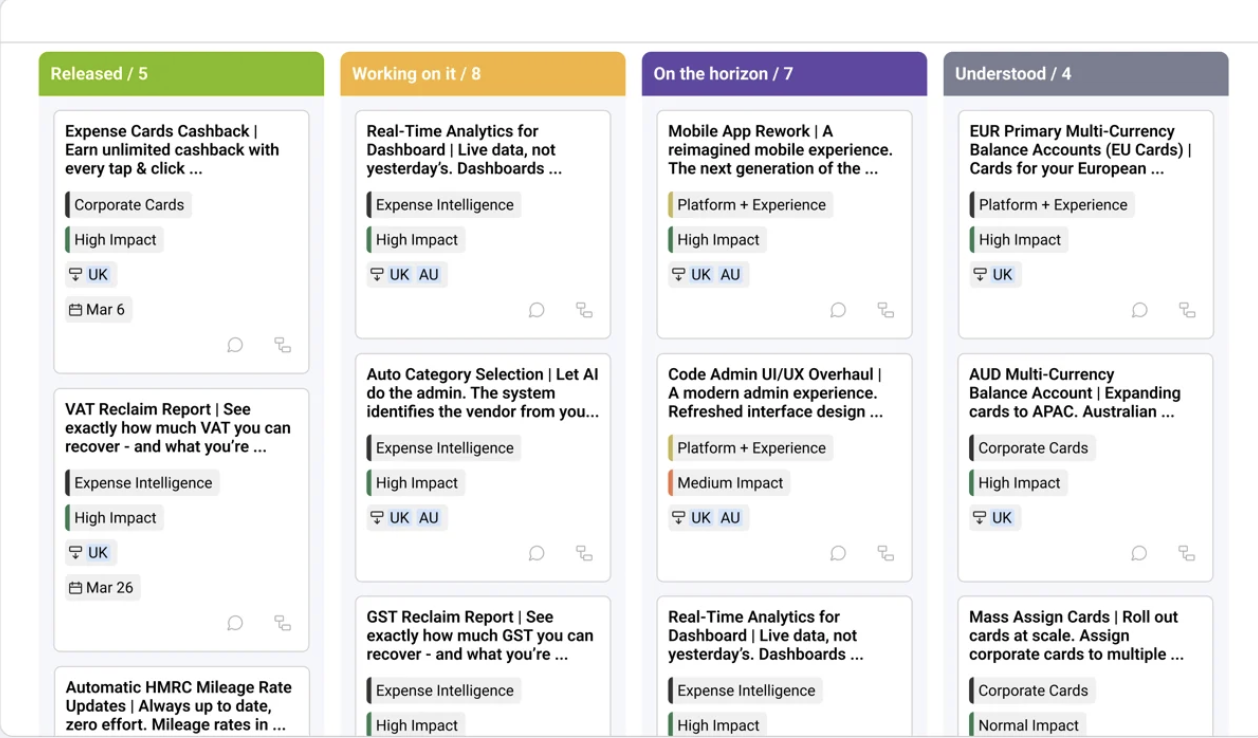
Broadly speaking, our roadmap is organised into four columns. And it’s worth understanding what each one actually means.
- Released is what’s already shipped.
- Working on it is in active development — these are features with resource behind them right now.
- On the horizon means confirmed priorities. Not speculative, not “we’re thinking about it”. But things we’ve committed to building.
The fourth column is perhaps the most unique one. And it’s something that most companies, even the ones who do publish their product roadmap, wouldn’t include at all.
What ‘Understood’ actually means
The fourth category on our roadmap is ‘understood’. Understood means we’ve received the request, we understand the need, and we’ve made a conscious decision about where it sits in our priorities right now.
Most companies handle this by saying nothing. Feature requests disappear into a void. You never find out if it was considered and deprioritised, forgotten, or simply never realistic in the first place.
The Understood column is our answer to that. It’s an honest acknowledgement that not everything can be built at once – and a commitment to keeping you informed rather than leaving you guessing.
Some items in that column will move into active development as priorities evolve. If that changes, you’ll see it. If it doesn’t, you’ll know that too.
This is also why, for our existing customers and partners, your product board submissions matter more than you might think. The Understood column doesn’t emerge from nowhere: it reflects what we’ve heard, considered, and made an active call on.
When you submit feedback through our product board, you’re directly shaping what gets elevated into active development. We don’t make the board publicly available, but that’s precisely the point. It’s a space where customers who are invested in the platform can have a genuine influence on where it goes next.
If you’re not already using it, I encourage you to get involved. Drop your account manager a line and they’ll send a link to join our product board.
A note on the AI features
You will notice AI appears on the roadmap. We want to be straightforward about what that means in practice, since there’s quite a lot of snake oil out there right now. And, frankly, some legitimate reasons to be cautious.
One concern we hear from finance teams is around data. Specifically: if AI processes your expense data, where does it go, and could it be used to train models or end up somewhere it shouldn’t?
It’s a fair question, and it deserves a straight answer. The AI features we build operate on your data, not with it. We don’t use your expense data to train models, share it with third parties, or feed it into anything outside your environment.
Your data stays yours. The AI is doing pattern recognition and automation on information you’ve already put into the system. It’s not doing anything with that data beyond the task at hand.
What that looks like in practice: auto category selection reads a receipt, identifies the vendor, and matches it to your category list. That’s it. The same data your team was already entering manually, handled automatically, kept entirely within your platform.
Every AI feature we ship has to earn its place by solving a real problem. No grand claims. Just tedious jobs, handled auto-magically. We will keep integrating AI this way — feature by feature, where it genuinely helps — and the roadmap will reflect that as we go.
What we’re committing to
If something is on this roadmap, we’re working on it (or it’s already shipped). If priorities shift and something changes, we’ll update the roadmap and let you know. No features that quietly disappear. No promises made in sales calls that never materialise.
This sits alongside our broader commitment to being straightforward with you. Our expense management software is built on the principle that managing expenses should be simple, visible, and well-controlled.
The roadmap is built on the same principle: you should be able to see what you’re going to get (and when).
If you want to stay up to date as new features ship, you can sign up for product release notifications on the roadmap page.