There is a narrative doing the rounds right now that AI agents will replace software. The per-seat model is dead. The incumbents are finished. Some financial analysts are calling it the ‘SaaSpocalypse‘. A cool moniker, I’ll grant them.
We are SaaS, for what it’s worth. SaaS being the industry shorthand for software you access over the internet rather than install yourself. Salesforce is SaaS. Xero is SaaS. You get the idea. The question some are asking is ultimately: if AI makes it this easy to build software, why would anyone pay for it?
Vibe coding expense management
Which brings us to vibe coding (the latest in a long sequence of death knells for SaaS). There are platforms now where you can go from blank project to a working expense app — live charts, budget limits, the lot — in an afternoon, without writing a line of code.
The question is not whether you can. Of course you can. You can do lots of things. You could whip out your credit card right now and buy a jet ski. To paraphrase Dr. Ian Malcolm from Jurassic Park, the question is not ‘can you’, it’s ‘should you’.

For a solo founder or a team of five, a no-code expense tracker is a perfectly reasonable starting point. But once you are running a business with real headcount, real compliance obligations, and real financial consequences for getting things wrong, the calculation changes significantly.
The build is the easy part
When people weigh up vibe coding versus buying dedicated software, they tend to focus on the subscription cost. That is the visible number. What gets missed is everything else.
You build the app. It works. Three months later, your team grows, your policy changes, or someone at HMRC decides to clarify the mileage rules. Who updates the tool? That is you. Who handles the UI when a new hire cannot figure out how to submit a claim? Also you. When something breaks mid-month and a dozen employees are waiting to be reimbursed, where is the support line? There isn’t one.
The platform lending you the compute is not in the business of fixing your specific instance. You are essentially renting a very capable set of Lego bricks. The assembly, the maintenance, and the repair work are all yours.
This is not a knock on the tools themselves. They are genuinely impressive. But there is a meaningful difference between a product and a feature. What you get when you vibe code is a feature set. When managing employee spend at scale, you’ll need a specialist product (with all the unsexy stuff that comes with it):
- Onboarding flows
- Policy enforcement
- Approvals hierarchies
- Integrations with your accounting system
- Someone to call when things go sideways.
The audit problem
Here is where it gets serious. If you’re ever subject to an audit you’ll need to demonstrate that your expense process has proper guardrails in place. Auditors will want to follow a claim from submission through to reimbursement, reviewing receipts, categories, policy compliance, and approvers at each stage.
A vibe-coded tracker built in an afternoon does not come with that audit trail baked in. You would need to build it. Then maintain it. Then make sure it holds up to scrutiny from someone who does this for a living. The risk of getting that wrong is not a bug report. It is a fine, a retrospective payment demand, or something worse.
Dedicated expense management software is built specifically to carry that compliance burden. Digital compliance means every claim is checked in real time against your policy, anomalies are flagged before they become problems, and a full audit record is maintained automatically. That is not an add-on. It is the point.
The black box problem in finance AI
There is a broader conversation happening right now about trust and AI in finance, and it is relevant here as well.
Sage CEO Steve Hare, speaking at the company’s recent user conference, argued that finance teams will not trust AI they cannot interrogate. “You can’t outsource your personal accountability,” said Hare. “Whether you’re using a human or whether you’re using a machine to calculate numbers, to prepare the accounts, you’re responsible for that.”
The AccountingWEB piece covering these comments is worth reading in full.
The point applies directly to vibe-coded financial tools. The outputs of a no-code expense tracker are not inherently untrustworthy. But the system that produces them is opaque, unmaintained, and carries no obligation to be accurate.
When your finance director is signing off the numbers, they need to be able to show their workings. Research from Sage and IDC found that 71% of finance leaders would reject an AI system if it cannot explain its outputs, even when those outputs are highly accurate.
In finance, you can’t outsource the responsibility for the numbers to a machine.
Scale is where the vibes end
A vibe-coded tool built for 10 people will not automatically scale to 100. The approval workflows become unwieldy. The receipt management becomes a mess. Once you cross 50 employees, expense processes that worked fine at 20 start to creak: submissions pile up, approvals get delayed, and visibility over what is actually being spent disappears.
This is the inflection point that a purpose-built platform is designed for. Fraud detection, VAT reclaim, mileage verification, policy enforcement at the point of claim, integrations with Xero, Sage, or NetSuite: all of this requires infrastructure that takes years to build and refine.
You’re not just buying software when you choose a dedicated expense management platform. You’re buying the accumulated decisions of an engineering team that has spent a long time thinking about exactly these problems. (The gist here is pretty similar when considering a specialist solution or an expense module bolted on to your accounting software).
SaaSpocalypse now?
As for the SaaSpocalypse: the expense management category is not threatened by the existence of no-code tools, any more than the accounting software category was threatened by the arrival of spreadsheets.
Spreadsheets are still everywhere. So is accounting software, for that matter. Because the latter does something the former cannot: it enforces process, carries compliance weight, and scales with the organisation using it.
The question of whether SaaS multiples recover is a market question. The question of whether you need robust, auditable expense management in your business is an operational one. The answer to the second question has not changed.
What a dedicated platform actually does
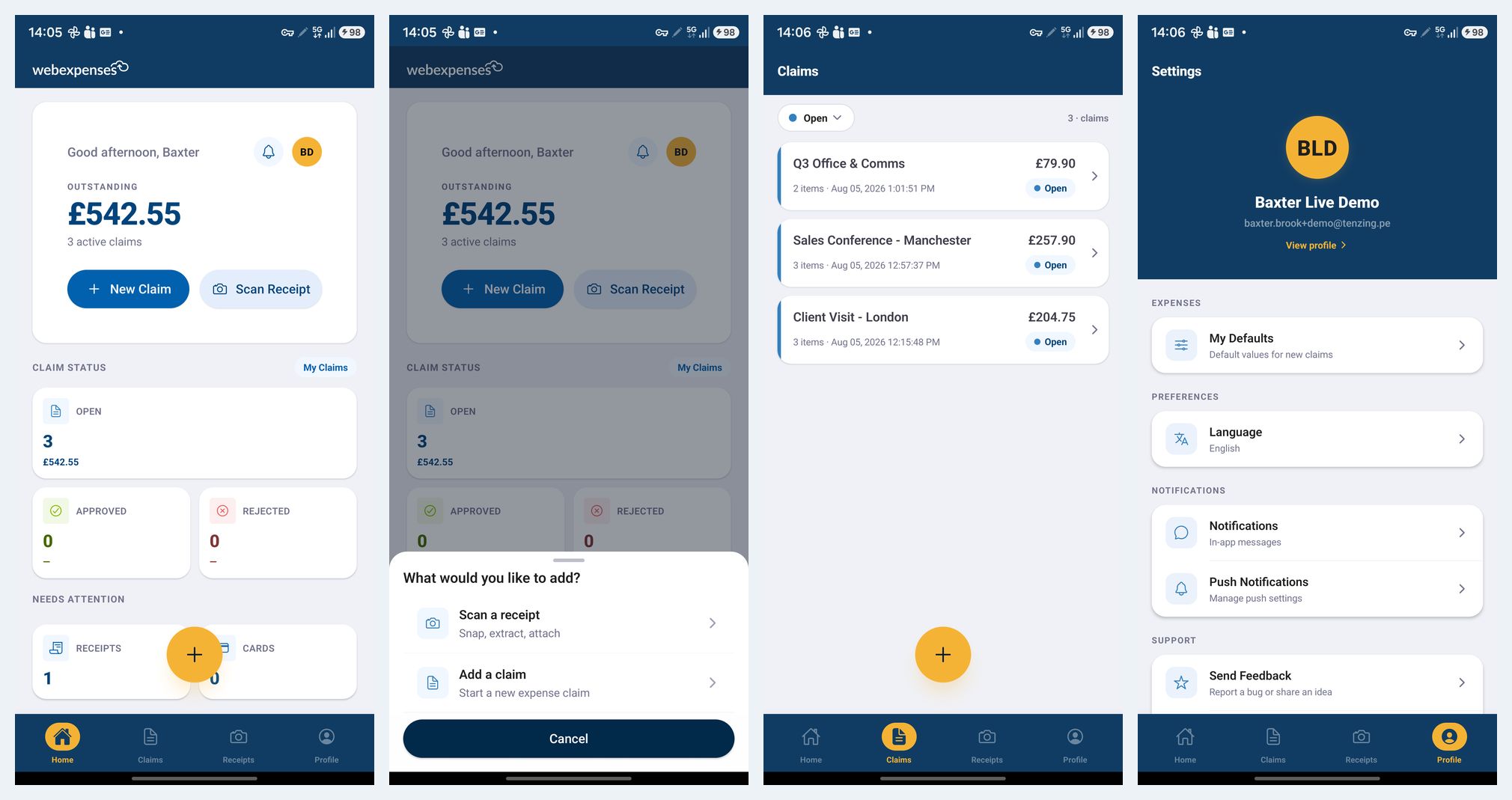
Webexpenses is built to manage employee expense claims end to end, from mobile receipt capture through to reimbursement and reporting. Using OCR, employees photograph a receipt and the claim is built automatically, removing the manual entry that creates errors.
Claims are checked in real time against your expense policy at the point of entry: anything that falls outside approved limits is flagged before it even reaches your approvals queue.
Our platform maintains a full audit trail across every claim, with approval records, receipt archives, and policy compliance data all stored and accessible. It integrates with all the main accounting and ERP systems, including Xero, Sage, NetSuite, and Microsoft Dynamics. So data flows without manual reconciliation. And there is a dedicated audit service for teams who want an additional layer of impartial review.
For teams managing corporate card spend alongside expense claims, we now offer corporate cards with up to 0.75% unlimited cashback. No thresholds or category restrictions. All spend, whether on card or claimed by employees, sits within a single platform with consistent visibility and control.
The vibe-coded tracker will get you started. When you are ready to run a proper process, you know where to find us.
Want to move beyond vibes? Book a demo with Webexpenses and we’ll show you what a specialist expense solution can offer.