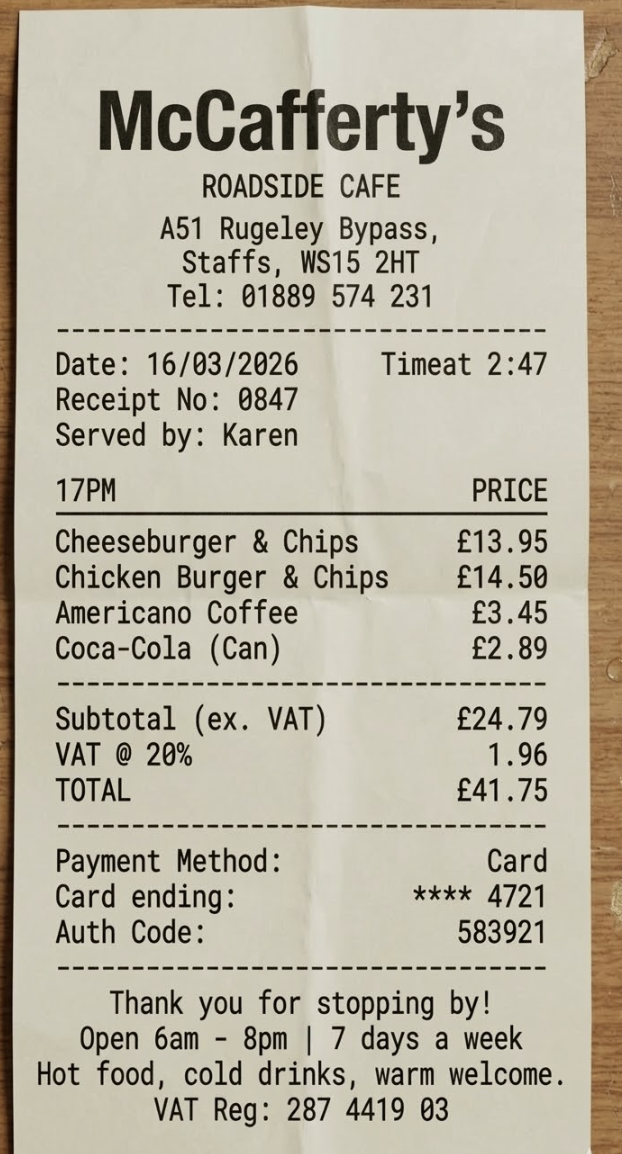
For most people, AI image generation is still a bit of a novelty – something you use to turn a photo of yourself into a Studio Ghibli character, or age your face by 40 years for a laugh. But the same technology that puts your boss in a Pixar film can produce a convincing restaurant receipt in about 30 seconds – and the tools that do it are, for now anyway, free.
Put simply, AI expense fraud means fake receipts – and increasingly, fake invoices and other financial documents – generated in seconds and submitted for reimbursement. It is a growing and material risk for any organisation that reimburses employee expenses. And the barrier to entry has never been lower.
Anyone with a smartphone and access to a free AI image tool can generate a convincing-looking receipt in seconds. No design skills needed or specialist knowledge required. Just a prompt and, voila, out comes something that looks like it came from a restaurant, a hotel, or a taxi firm.
Why traditional checks are no longer enough
This is not a hypothetical risk. Fake AI receipts accounted for around 14% of fraudulent documents submitted in 2025, compared to none the previous year.
For finance teams still relying on manual processes and paper-based checks, this is a problem that is already happening – and it is getting harder to catch.
The old approach to expense fraud prevention was, at least in principle, straightforward. You ask employees to submit receipts, a finance team member reviews them, and anything suspicious gets queried.
It was never perfect, but it worked reasonably well when receipts were physical documents with obvious signs of tampering.
That model does not hold up against AI:
| Traditional receipt fraud | AI-generated fraud | |
| Common methods | Photocopied receipts, altered amounts, fake merchant names. | Fully synthetic receipts generated from a text prompt. |
| Visual tells | Visible: smudging, inconsistent fonts, obvious edits. | Minimal: realistic thermal texture, natural creases, authentic blur. |
| Tools required | Scissors, a scanner, basic image editing. | A free AI tool and 30 seconds. |
| Detectable by eye | Often, with care. | Rarely, even by experienced reviewers. |
Are physical receipts the answer?
Asking your team to retain physical receipts is one response to this. And in some contexts it is a reasonable procedure. But it comes with its own problems. You are, in effect, returning to a shoebox model of expense management — slow, admin-heavy, and full of operational friction.
For teams spread across different locations or time zones, it quickly becomes unworkable.
Take us as a practical example: our finance team is based in the UK, but we have colleagues working on the Sunshine Coast in Australia.
Requiring physical receipt submission for every expense is not a realistic ask. What would we do? Courier the stacks of receipts across ten time zones? The postage alone would be absurd. And the delays would make reconciliation a nightmare.
But then, geography should not be a reason to leave your expense management exposed.
What good fraud prevention looks like
Catching fraud after the fact is harder, more expensive, and more damaging to workplace culture than preventing it at the point of spend. The most effective approach is structural. In other words, create fewer opportunities for fraudulent receipts to enter your expense workstream in the first place.
Short-term measures worth putting in place
Overhauling your expenses process takes time, and in the meantime your finance team is still dealing with incoming claims. There are some practical steps you can take right now that will add meaningful layers of protection without requiring any major changes to how you work:
- Cross-reference submitted receipts against card transactions to catch discrepancies early
- Run duplicate detection to prevent the same receipt being submitted more than once
- Set spend limit alerts on individual cards so out-of-policy claims are flagged before they reach approval
- Use contextual checks – does this receipt match the employee’s travel pattern? Is the spend in line with previous claims?
That said, these measures still place the burden on your finance team to catch problems after submission.
The more sustainable fix: Corporate Cards
The better approach is to change the underlying process so that a fake receipt, however convincing, simply cannot generate a successful claim.
Our Corporate Cards are built precisely to address this. Not by making fake receipts easier to catch, but by making them pointless to submit.
When an employee uses our Corporate Card, an expense record is created automatically from the transaction data. The transaction is real, verifiable, and tied to your company’s accounts.
And when spend is funnelled through our Corporate Card, it creates multiple layers of confirmation: from the merchant (via their payment processor), the card scheme (Mastercard), and Adyen all confirm transaction data at the point of authorisation.
Then the receipt from the employee adds another factor to authenticate the spend. If it matches, the claim moves forward. If it doesn’t – or if no corresponding transaction exists – the system flags it immediately.
Our Corporate Cards also work great for distributed teams. Whether your employees are in London or Lahore, the same controls apply. There’s no physical receipt submission, no international post or courier costs, no manual reconciliation across locations, and no inconsistent review standards between teams.
Every transaction is tracked in real-time, with full visibility available to your finance team from a single dashboard.
Corporate Cards: fraud free and frictionless
Beyond fraud prevention, our Corporate Cards also remove the reimbursement cycle entirely for card-based spend. Employees are not out of pocket while they wait for claims to be processed.
You’re not chasing receipts or manually reconciling card statements. Spend limits can be set for individual cards. So out-of-policy purchases are blocked before they happen, not queried after the fact. You can also prohibit the purchase of certain categories of goods.
Cards can be issued instantly (virtually) or as physical cards. And they’re fully integrated within our platform alongside your existing out-of-pocket claims process. You do not have to choose between the two – both are managed in one place, under one system.
Want to see how Corporate Cards work in practice? Book a demo with us and we’ll show you how the receipt matching and real-time controls work for you.