Webexpenses has long supported multi-entity expense management – separate legal entities, all under one platform. Now that same multi-entity capability is available with our Webexpenses Cards.
You can issue cards across multiple legal entities, you can run them the same way you run your expenses: separately where it matters, together where it helps.
Why one account just won’t cut it
In many cases, a single expense account makes sense. There are a handful of employees, one entity, and one pot of money to keep track of. Boom, sorted.
Then you grow. You gain a subsidiary, you restructure into two trading entities, you open a division that needs to operate independently for accounting purposes. And suddenly the platform (or spreadsheet) that served you well is causing you nightmares.
Your finance team is spending hours manually separating transactions. Your reconciliation process has become a monthly ordeal. And any audit trail you’re expected to provide is, at best, a patchwork.
This is the point at which multi-entity expense management stops being a nice-to-have and becomes a serious operational need.
The cost of forcing the wrong tool
When you can’t separate balance accounts by entity, you can’t get an exact picture of what each company is spending.
Here’s what that tends to look like in practice:
- You issue expense cards to employees across different subsidiaries, but they all draw from the same pool of funds.
- Reconciling which entity owes what becomes a manual exercise, usually in Excel, usually at month-end, usually under pressure.
- The finance team builds workarounds – naming conventions, colour-coded trackers, ad hoc reports – that keep things moving but don’t actually solve the problem.
Then there’s the fact that each legal entity you run has its own statutory obligations – separate accounts to file, separate VAT positions, separate director responsibilities.
That’s all manageable without entity-level software. But if your system can’t separate spend by entity, someone is doing that separation manually. And manual means slow, expensive, and exposed to error during times – audit, year-end, a regulatory query – when accuracy matters most.
What proper multi-entity expense management actually looks like
Multi-entity expense software means a platform that lets a parent organisation manage multiple separate legal entities under one account, with independent financial controls, reporting, and card operations for each.
In practice, it means your central finance team can see everything from a single parent-level view. And each entity keeps its own balance account, its own cards, its own divisional structure and card operations. You get centralised control with entity-level separation.
Each entity goes through its own verification process. Each has its own pool of funds, topped up independently by you. Cards issued to employees in one entity draw only from that entity’s balance. Transactions and statements are all filtered by entity. And when it comes to month-end, reconciliation is no longer an exercise in manual detective work. The data is already structured correctly.
This kind of setup also means your expense card management runs at the right level of granularity. You can set spend limits per cardholder over daily, weekly, or monthly periods. And you can freeze and unfreeze cards by entity. Viewing the full transaction history for any given legal entity is also cleaner and not muddied by spend from another.
Does this all sound familiar?
If any of the following sounds familiar, you’re likely at the point where standard software is holding you back:
- You manage more than one UK-registered legal entity and currently run them through a single expense account.
- Your finance team is manually separating entity-level spend at month-end.
- You can’t produce entity-specific account statements without significant manual effort.
- You’re growing – through acquisition or internal restructuring – and you know the current setup won’t scale.
You don’t necessarily need to be a big enterprise for any of these to apply. A group of two or three entities, each with its own regulatory and financial obligations, faces exactly the same structural problem as a larger group.
The question is the same: how do you keep genuine financial separation without running entirely separate platforms, paying for multiple licences, and losing the visibility that comes from having everything in one place?
What we’ve built with Webexpenses Cards multi-entity
Webexpenses Cards with multi-entity support is designed specifically for the problems we’ve described. And it brings Cards into line with what Webexpenses has long supported on the expenses side. Meaning you now have genuine multi-entity capability across the full platform, in one place.
Each legal entity is set up separately within the platform, with its own KYC onboarding process handled via our trusted payments partner, Adyen. That might sound like extra work, but it’s the right foundation – it means each entity is properly verified and financially distinct from the outset.
Once verified, you can issue physical and virtual cards to employees within that entity, set spend limits at the individual, and fund each entity’s balance account independently.
The Entity Summary Dashboard gives you a combined view across all your entities – KYC status, country, currency, and mapped divisions – all in one place. You’re not logging into separate platforms or toggling between accounts. Everything is visible from the parent level but controlled at entity level.
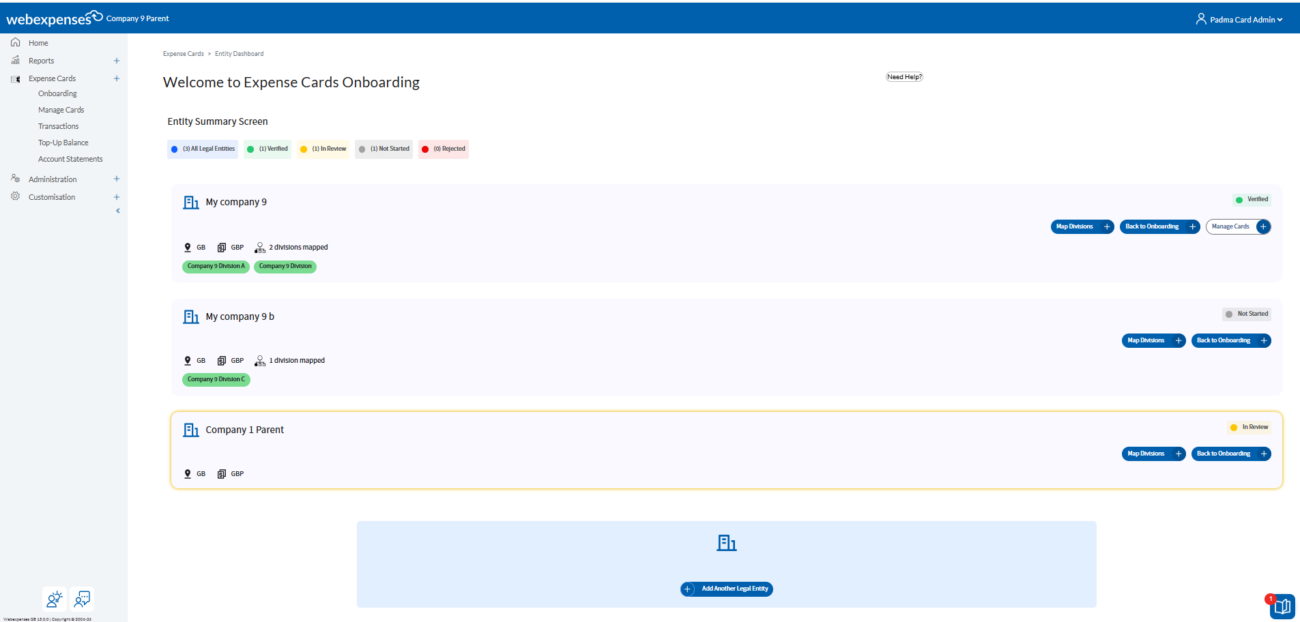
Transactions are filtered by entity, so your finance team can view activity, pull statements, and reconcile without any manual separation work. Spend limits can be set on a daily, weekly, or monthly cycle per cardholder.
Cards can be frozen instantly – by the admin, or by the cardholder themselves if a card is misplaced. Only the Expense Card Administrator can unfreeze them. Cancellation, when needed, is a controlled, auditable process.
Multi-currency is coming soon
For now, multi-entity Cards operates in GBP. If you’re running or planning European entities, EUR multi-currency balance accounts are coming soon. You can see exactly where that sits on our public product roadmap.
For finance teams that currently manage multiple entities through workarounds, the shift is significant. You can do more, with less work. The whole thing is built to scale: adding a new entity means going through the onboarding process for that entity, not retrofitting a system that was never designed for more than one.