The HMRC mileage rate, or if we’re being more formal: the Approved Mileage Allowance Payment (AMAP), is the amount you can pay an employee, tax-free, for using their own vehicle on a business journey.
In other words, rather than reimbursing fuel, insurance and wear and tear separately, HMRC sets a single pence-per-mile figure that covers all of it in one payment.
The HMRC mileage rate for 2026/27 is 55p per mile for the first 10,000 business miles in a car or van. Then it’s 25p per mile after that. And that’s big news, because it’s the first increase since 2011. The 22% uplift confirmed by the Chancellor in May 2026 and backdated to 6 April 2026.
Motorcycles are reimbursed at 24p per mile and bicycles at 20p, with no mileage threshold on either. If an employee carries a colleague on a business journey, you can add a further 5p per mile per passenger on top of the standard rate.
Below, we’ll walk through exactly how these rates work, what counts as business mileage, how Advisory Fuel Rates apply if you provide company cars, and how to keep your reimbursement process accurate without it eating into your finance team’s week.
HMRC mileage rates for 2026/27
Here are the approved rates from 6 April 2026 to 5 April 2027.
| Vehicle type | First 10,000 miles | Over 10,000 miles |
| Cars and vans | 55p per mile | 25p per mile |
| Motorcycles | 24p per mile | 24p per mile |
| Bicycles | 20p per mile | 20p per mile |
These rates apply from 6 April 2026 to 5 April 2027. The two-tier structure for cars and vans means the rate drops from 55p to 25p once an employee’s cumulative business mileage crosses 10,000 miles in the tax year. That count resets every April.
Pay at or below the approved rate and there’s nothing to report and nothing to tax. Pay above it, and the difference counts as a taxable benefit. This’ll need to go through payroll or a P11D and picks up National Insurance along the way.
Pay below it, and your employee can claim the shortfall back through Mileage Allowance Relief (MAR). This shifts admin onto them, and HMRC, rather than you.
If an employee gives a colleague a lift on a business trip, you can add an extra 5p per mile per passenger on top of their own rate, provided the passenger is also travelling on business. It’s a small detail, but one worth building into your policy properly rather than leaving to guesswork.
Why the mileage rate has increased
The 45p rate had been frozen since 2011, a time when petrol was £1.35 a litre and the average house price was around £150,000. So it’s fair to say the rate stopped reflecting the real cost of driving for work years ago. Indeed, motoring and tax bodies, including the RAC and the Association of Taxation Technicians, had been pushing for a review for some time.
In May 2026, the Chancellor announced a 10p increase, taking the rate to 55p per mile for the first 10,000 business miles. It was backdated to 6 April 2026. So it applies to the whole of the current tax year, including any journeys already reimbursed at the old rate.
If you’ve been paying 45p since April, it’s worth checking whether you owe your team the difference. The rate above 10,000 miles, and the rates for motorcycles and bicycles, are unchanged.
How to calculate your mileage reimbursement
The calculation itself is straightforward. Multiply the miles driven by the relevant rate, switching to the lower rate once an employee passes 10,000 business miles in the tax year.
For example, an employee drives 12,000 business miles in their own car over the year. The reimbursement works out as:
- First 10,000 miles: 10,000 × 55p = £5,500
- Next 2,000 miles: 2,000 × 25p = £500
- Total: £6,000, all tax-free
That’s easy enough to work out for one employee. It gets harder once you’re tracking dozens of people, several vehicle types, and a rolling 10,000-mile threshold that resets each April. A missed threshold, or a rate applied to the wrong vehicle, is one of the more common findings in an HMRC compliance check.
A closer look at each vehicle type
Cars and vans
The 55p/25p structure applies regardless of engine size, fuel type, or the age of the vehicle. That includes hybrids, which follow the same rates as petrol and diesel cars.
It also includes personally owned electric vehicles. There’s no separate AMAP rate for an employee’s own EV, even though the running costs of an EV look quite different to a petrol or diesel car. For now, the standard 55p/25p rate applies across the board.
Say your employee drives 11,000 business miles in her own hybrid over the year. You’d reimburse 10,000 × 55p = £5,500, plus 1,000 × 25p = £250. That’s £5,750, tax-free.
Motorcycles
Motorcycles are reimbursed at 24p per mile, with no two-tier structure and no 10,000-mile threshold to track. Whether an employee rides 500 miles or 15,000, the rate stays the same.
Bicycles
Cycling counts too, at 20p per mile with no mileage cap. It’s a modest rate, but for anyone who regularly cycles between sites or to client meetings, it adds up, and it’s a straightforward way to encourage greener travel across your team. If you’re already tracking spend, it’s worth pairing your mileage data with carbon footprint tracking to get the full picture of your travel emissions.
What counts as business mileage
This is where a surprising number of claims go wrong. Not every work-related journey qualifies.
Journeys that do qualify
- Travelling between office locations.
- Visiting a client, customer or supplier.
- Attending a temporary workplace, meaning somewhere an employee works for 24 months or less.
- Travelling to a conference, training session or meeting away from the usual workplace.
Journeys that don’t qualify
- The daily commute to a permanent workplace.
- Any travel for private purposes, even if a work call happens along the way.
- Travel to a location so close to the regular workplace that it’s effectively the same place.
The distinction between a temporary and permanent workplace catches people out most often, and it’s worth building clear examples into your expenses policy rather than leaving employees to interpret it themselves.
One more point worth flagging: the mileage allowance is the only tax-free way to reimburse business mileage. A flat cash allowance or a fuel card is taxed differently. And parking or tolls are handled separately, under subsistence rather than mileage.
Company cars and advisory fuel rates
If you provide company cars or vans, the AMAP rates above don’t apply. Instead, you’re working with Advisory Fuel Rates (AFRs), which refer to the HMRC-set figures used to reimburse employees for business travel in a company car, or to calculate what an employee owes back for private mileage.
HMRC reviews AFRs every quarter, on 1 March, 1 June, 1 September and 1 December. You can carry on using the previous rates for up to a month after a new set is published. So there’s a short window to update your systems.
Here are the rates effective from 1 June 2026:
Petrol
| Engine size | Advisory fuel rate |
| Up to 1,400cc | 14p per mile |
| 1,401cc to 2,000cc | 17p per mile |
| Over 2,000cc | 26p per mile |
Diesel
| Engine size | Advisory fuel rate |
| Up to 1,600cc | 15p per mile |
| 1,601cc to 2,000cc | 17p per mile |
| Over 2,000cc | 23p per mile |
Hybrid company cars are treated as petrol or diesel, depending on the engine, rather than getting a rate of their own.
Electric vehicles
For fully electric company cars, HMRC uses a separate Advisory Electric Rate (AER), split by where the vehicle is charged: 7p per mile for home charging and 15p per mile for public charging.
The gap reflects a real difference in cost. Home electricity is taxed at 5% VAT, public charging at 20%, so a driver relying on public networks costs noticeably more to reimburse. This means tracking where a journey was charged, not just how far it went. Which is a step up in complexity from the old single-rate system.
We’ve written in more depth on what changed with the new EV mileage rates and how to manage the added detail without it becoming a burden on your finance team.
Benefit charges
Van and car fuel benefit charges have also increased for 2026/27, in line with inflation:
| Charge | 2025/26 | 2026/27 |
| Van benefit charge | £4,020 | £4,170 |
| Van fuel benefit charge | £769 | £798 |
| Car fuel benefit multiplier | £28,200 | £29,200 |
Zero-emission vans keep their nil rate under the van benefit charge. So a fully electric van in your fleet won’t create a taxable benefit for the driver.
Common mileage mistakes
- Using AMAP rates for a company car, or AFRs for a personal vehicle. They’re not interchangeable, and mixing them up is a common finding in HMRC compliance reviews.
- Losing track of the 10,000-mile threshold. It’s cumulative across the tax year, not per trip, and it resets every April.
- Accepting commuting claims. Home to a permanent workplace doesn’t qualify, even if a work call happens along the way.
- Weak record-keeping. HMRC can ask for mileage logs going back several years. And a log made at the time of the journey holds up far better than one reconstructed months later.
- Paying above the approved rate without reporting it. Anything over 55p per mile is taxable and needs to go through payroll or a P11D.
How to report mileage to HMRC
Most mileage paid within the approved rates doesn’t need reporting at all. But there are situations where it does.
If an employee drives more than 10,000 business miles, anything paid above 25p per mile for the miles over that threshold goes on a P11D or gets payrolled as a benefit.
If you pay above the approved rate at any point, the excess is a taxable benefit and needs reporting. And if you pay below the rate, your employee can claim Mileage Allowance Relief directly from HMRC, using a P87 form if they don’t file a Self-Assessment return.
Our support article on HMRC mileage rates walks through the reporting process in more detail, including how the thresholds interact with payroll.
Frequently asked questions about mileage
What is the HMRC mileage rate for 2026/27?
55p per mile for the first 10,000 business miles in a car or van, then 25p per mile after that. Motorcycles are 24p per mile and bicycles are 20p per mile, both uncapped.
Has the mileage rate changed this year?
Yes, it has. The car and van rate rose from 45p to 55p in May 2026, backdated to 6 April 2026. It’s the first change since 2011.
Do these rates apply to electric and hybrid vehicles?
Yes, if the employee owns the vehicle. Personally owned EVs and hybrids follow the same 55p/25p structure as petrol and diesel cars. Company-owned EVs use a separate Advisory Electric Rate instead.
Can employees claim mileage for their commute?
No. Travel between home and a permanent workplace doesn’t qualify. Eligible journeys include client visits, travel between sites, and trips to a temporary workplace.
What happens if I pay employees more than the approved rate?
You treat the excess as a taxable benefit. You need to report it through payroll or a P11D, and it attracts Class 1A National Insurance.
How Webexpenses makes mileage simple
Manually tracking mileage across a team, several vehicle types and a rolling 10,000-mile threshold is where most of the errors above creep in. Webexpenses handles the calculation for you.
Every claim is automatically matched to the correct HMRC rate for the vehicle type. And the system tracks each employee’s cumulative business mileage across the tax year, switching from 55p to 25p the moment they cross the threshold, without anyone needing to check a spreadsheet.
Screenshot suggestion: the claim submission screen, showing the rate auto-applying as mileage is logged and the running year-to-date total.
Journeys are logged through built-in mapping. So employees plot a route rather than typing an estimate, and can add multiple stops for multi-leg trips. A recents and favourites feature saves regular journeys and charging points, which is a small thing but saves real time for anyone driving the same client route every week.
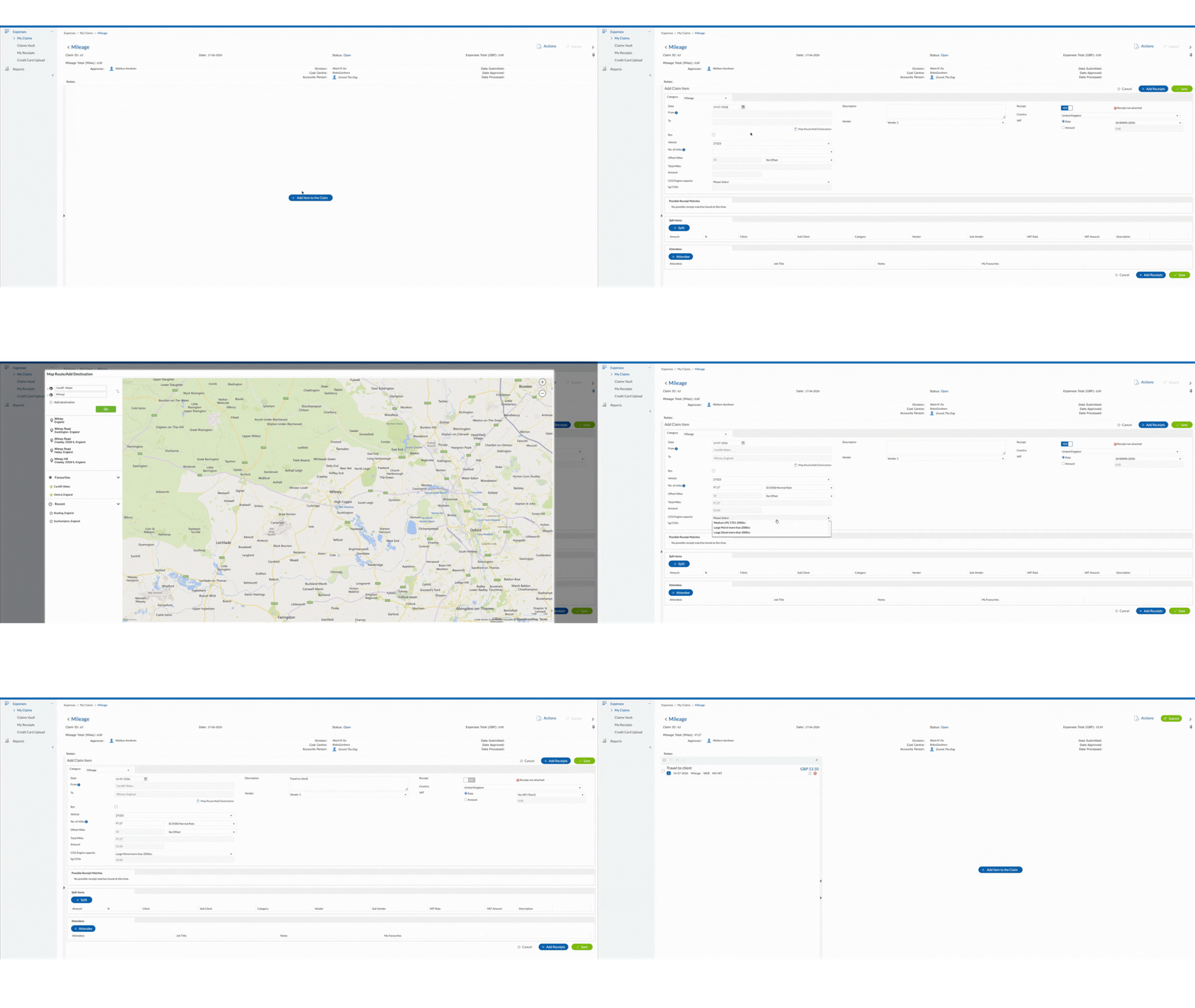
For EV drivers, Webexpenses supports the split home and public charging rates, letting employees break a single journey into segments and specify where each leg was charged. So your reimbursement stays accurate and your VAT reclaim stays defensible. And because every claim carries a timestamped, auditable record, you’ve got a clean trail ready if HMRC ever asks to see it.
If you’re managing this across multiple entities or vehicle policies, that same audit trail and rate logic applies consistently, so nothing falls through the cracks between teams.
See our system up close
None of this replaces good policy. But it does mean the policy actually gets followed. Without your finance team spending their week chasing down the right rate for the right vehicle for the right journey.
Our corporate travel and expense management platform brings mileage, cards and reporting together in one place, so you’re not stitching together separate tools to stay compliant.
If mileage claims are still living in spreadsheets, or you’re not confident your rates are switching correctly at 10,000 miles, it’s worth seeing how much of this can run itself.
Book a free demo and we’ll show you exactly how it works with your current fleet and policy.