
Every time you hire, open a new site, or bring on a new team, the expense volume goes up. If your current process requires a human to touch every claim, your finance overhead scales with your headcount. That’s a choice, not an inevitability.
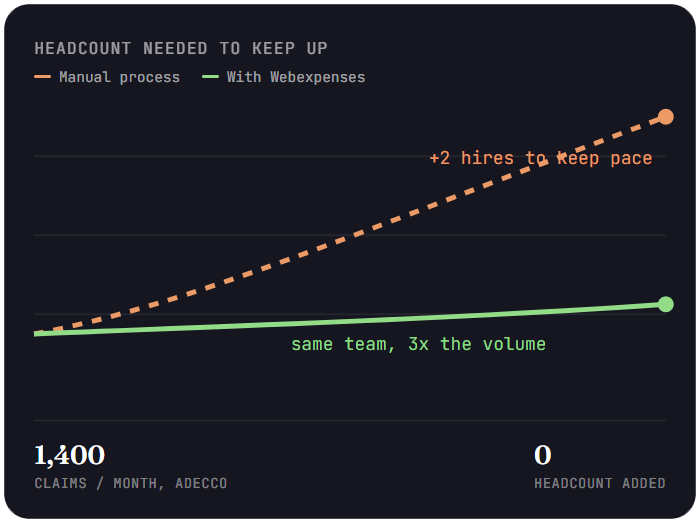
Most finance teams reach a point where the choice feels binary: either hire another person to handle the volume, or fall behind. Expense processing, GL coding, card reconciliation, policy checking: all of it takes time, and all of it grows proportionally with the size of the business.
Webexpenses breaks that proportionality. The platform handles the processing. Your finance team handles the exceptions, which is a small fraction of the total volume.
When employees submit claims, they select from cost centres and project codes configured to your chart of accounts. GL coding happens at source, not in finance. Your team reviews exceptions, the minority of claims where something needs human judgement, rather than every line.
Automated reminders go to employees before submission deadlines. Late submissions trigger escalation. Approvers get notified when claims are waiting. The entire chase cycle, the emails, the calls, the same conversation every month, is replaced by a process that runs itself.
Corporate card transactions match to receipts automatically. Claims post to the ERP directly. VAT is categorised at point of receipt. Month-end arrives with the data already clean, not with a pile of work to do before it can be clean.
Adecco merged three companies and 600 new staff onto a single Webexpenses platform and now processes 1,400 claims a month without adding a person to handle the volume. That’s the headcount argument made concrete: the business got bigger, the finance team didn’t have to.
Miele automated their expense process thoroughly enough to reallocate a full-time finance employee to higher-value work. Not a hypothetical efficiency saving; an actual person doing something else now.
Merz Pharma saved a full day of processing time every month after switching, worth roughly £10k a year to their finance function. It’s a smaller business than Adecco or Miele, which is useful: the effect isn’t limited to enterprise-scale headcount.

“I cannot stress how much better Webexpenses has been than our old paper based system. The management information now available to us is substantial, everything is there!”
Adecco Group, 1,400 claims a month, zero additional headcount
The most direct way to think about the ROI: what would it cost you to hire someone to do what Webexpenses does? Estimates commonly put a junior finance admin role in the UK at £25,000–£35,000 a year in salary, before NI, pension, management time, and the opportunity cost of that hire doing low-value work.
Webexpenses costs a fraction of that, and, as above, several customers have used it to avoid that hire altogether rather than just make it more efficient.
The figure varies a lot by business, but estimates commonly put fully-loaded manual expense processing at £15 to £25 per claim once you factor in employee time, finance staff time, error correction, and management overhead. The ROI calculator uses your specific numbers (team size, claim volume, current process) to give you a figure you can actually use in a business case, rather than relying on an industry average.
Not quite. It’s broader than just claimants. An active user is anyone who does at least one of the following in a given month: captures a receipt, builds a claim, approves a claim, processes a claim, or runs a report. So approvers and finance admins who never submit a claim themselves still count if they’re actioning things. What you don’t pay for: employees who log in but don’t action anything, and anyone who does nothing at all that month, such as seasonal staff between contracts or new starters who haven’t started yet. A claimant who’s also an approver is still billed as one user, not two.
It depends on your claim volume and current process cost, so there’s no single answer we’d stand behind as a headline figure. Customers like Merz Pharma have quantified savings in the region of £10k a year on processing time alone, and Fulham FC’s Financial Controller has put it at roughly half a day a month on reporting alone. The ROI calculator gives you a specific payback estimate for your setup rather than a generic number.
Your business is growing. Your expense volume is growing. Your finance team doesn’t have to. Webexpenses automates the work that currently scales with headcount.
Platform
FRONT OFFICE
BACK OFFICE
Capabilities
EXPENSES
ACROSS THE PLATFORM
TRUST AND ROADMAP