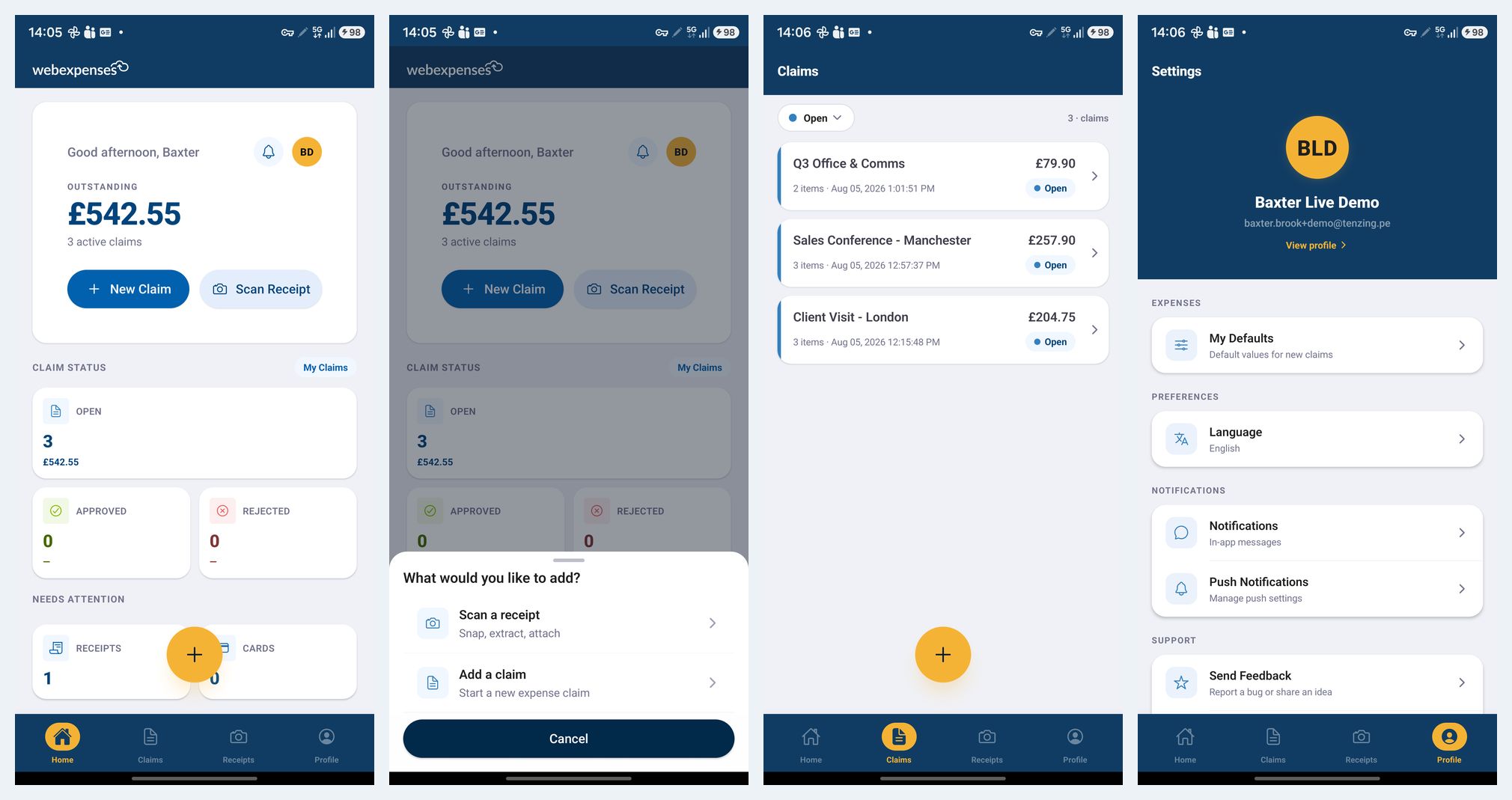
Mobile expense management lets your team capture receipts, log mileage and get claims approved from their phones, so employees are repaid sooner and finance sees spend while it’s still fresh.
This guide compares eight platforms businesses use for it, on the things that matter most to finance teams: app usability, reimbursement speed, integrations and policy control.
Disclosure: this guide is written and published by Webexpenses, a UK and APAC-based expense management provider. And we’re one of the platforms compared. We’ve based every competitor detail on the vendor’s own published information wherever it’s available, dated it to September 2026, and included our own trade-offs alongside everyone else’s.
Prices and plans change often, so check the latest details with each vendor before you buy!
The short answer
The best mobile expense management platforms for UK and APAC businesses combine receipt capture, mileage and approvals in one app with a quick route from spend to repayment.
Our shortlist, by what each does best:
- Webexpenses: best for UK and APAC finance teams at 50+ people companies that want claims, company cards and accounts payable in one eco-system.
- Pleo: best for small, card-led businesses.
- Rydoo: best for travel-heavy teams.
- Expensify: best for small teams that want simple expense reporting.
- Payhawk: good for multi-entity businesses that want cards and payables together.
- Spendesk: good for spend control.
- Zoho Expense: best for businesses already in the Zoho eco-system.
- ExpenseIn: best for small UK SMEs wanting a straightforward expense tool.
Mobile expense platforms compared
Prices are UK list prices from each vendor’s website, checked in September 2026. Most vendors discount for annual billing or larger teams. Please do double check for yourself!
| Platform | Mobile app | Accounting integrations | Company cards | Starting price |
| Webexpenses | Receipt capture, mileage, approvals and policy checks in the app | Xero and QuickBooks on every plan; MYOB Business in APAC, NetSuite, Sage Intacct and Business Central from Scale | Company Credit Card Reconciliation in Scale + Pro. Free virtual + physical Webexpenses Cards on every plan, with Apple Pay and Google Pay | From £7.50 per user per month/From $12 per user per month (APAC) |
| Pleo | Receipt capture and card management | Accounting integrations on every plan | Core product | From £8 per user per month |
| Rydoo | Receipt scanner and mileage on every plan | Xero and QuickBooks from the Pro plan | Add-on on Pro, included from Business | From £8 per user per month, billed annually, five-user minimum |
| Expensify | Receipt scanning, reports and approvals | Xero and QuickBooks Online on Collect; NetSuite and Sage Intacct on Control | Expensify Card, now available in the UK | From £8 per user per month, with an annual plan and the Expensify Card |
| Payhawk | Real-time card spend and receipt capture | Xero, QuickBooks and Exact; NetSuite and Dynamics on Enterprise | Visa cards, including credit | Custom quote |
| Spendesk | Receipt capture, approvals and card controls | Major UK accounting packages | Virtual and physical cards, with Apple Pay and Google Pay | Custom quote |
| Zoho Expense | Receipt capture and GPS mileage | Zoho Books plus major accounting packages. | Card feeds from the Standard plan | Free for up to three users; Standard from £3 per user per month, billed annually |
| ExpenseIn | Receipt capture and mileage | Major UK accounting packages | Expense card available | Custom quote |
What fast reimbursement actually means
When a platform promises ‘fast reimbursements’, check which part of the process it means. The time between an employee paying and getting their money back has three stages:
- Submission: how quickly the employee turns a receipt into a claim. A good mobile app makes this seconds, not days.
- Approval: how quickly the right manager signs it off. Automatic routing, policy checks and mobile approvals stop claims sitting in inboxes.
- Payment: how quickly money reaches the employee’s bank account.
Most delays happen in the first two stages, not the third. A claim submitted three weeks late, or stuck with the wrong approver, won’t be paid quickly however fast the bank transfer is.
Platforms handle payment in one of two ways. Some, such as Payhawk, pay employees directly from funds the company holds with them. That means keeping a balance topped up with the platform, and a scheduled payment can fail if that balance runs short.
Others, including Webexpenses, leave the money in your own bank account and give your finance team an approved, ready-to-pay list, so you decide when the money moves. That can be instantly, weekly or in line with payroll, and you never hand control of your cash to a third party.
The fastest option of all is not needing a reimbursement. With company expense cards, employees spend the company’s money directly. The transaction appears in the expense system as it happens, and nobody is out of pocket.
The platforms in detail
Webexpenses
Mobile app: employees photograph receipts for OCR capture, log mileage and submit claims in seconds from the Webexpenses mobile app, while managers approve from their phones and policy checks run as each claim is made.
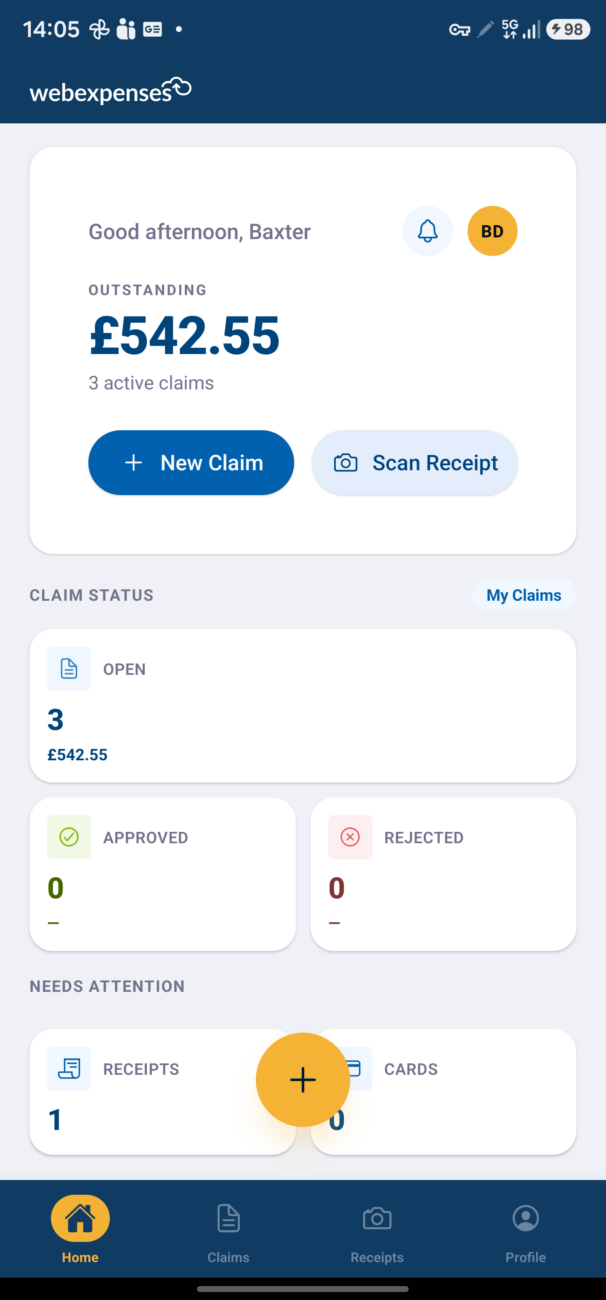
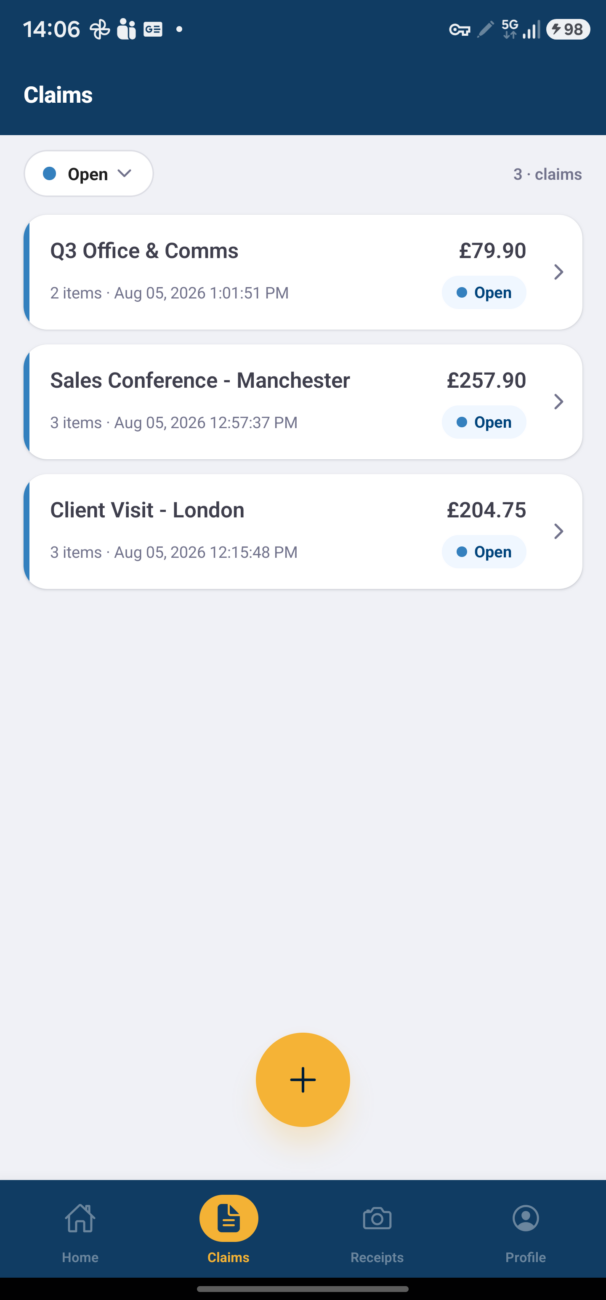
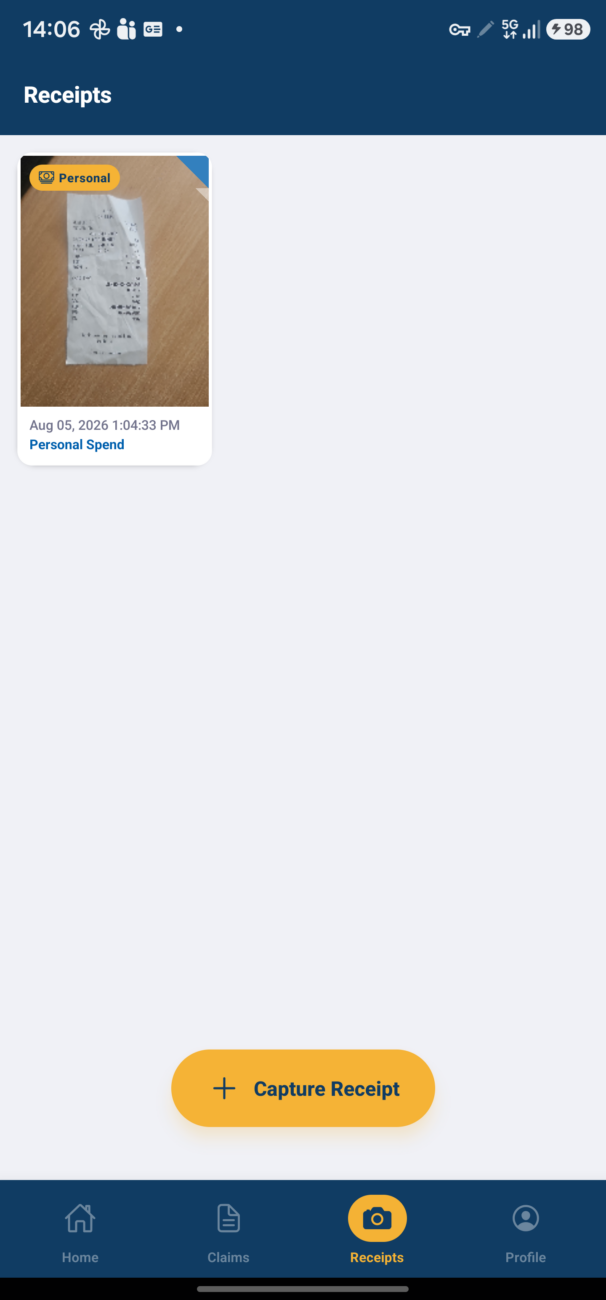
Getting paid: with free Webexpenses Cards, which work with Apple Pay and Google Pay, there’s nothing to reimburse. For out-of-pocket spend and mileage, approved claims go to your finance team ready to pay from your own bank account, instantly if you choose, or on whatever schedule suits. On Scale and Pro, existing corporate cards are reconciled automatically too.
Plans: Webexpenses, built in the UK 25 years ago, starts at £7.50 per user per month, with the app, claims, mileage and Webexpenses Cards on every plan. Scale and Pro add card feeds and uncapped cashback on Webexpenses Card spend, at 0.5% and 0.75%.
- Best for: UK finance teams that want expense claims, company cards, card reconciliation and accounts payable working together in one ecosystem.
- Watch out for: Webexpenses Cards are prepaid, so you load a balance before spending. Card feeds, carbon tracking and cashback need the Scale or Pro plans.
Pleo
Mobile app: built around the card, so employees see each transaction, snap the receipt and manage card spend from their phones.
Getting paid: on the £8 Start plan there’s no reimbursement at all, so all spending goes on Pleo cards. Out-of-pocket reimbursements and mileage claims arrive on Build, at £14, and Lead, from £499 a month, is the only plan listed with no reimbursement transaction fees.
Plans: Pleo, a Danish card-led platform, starts at £8 per user per month. Cashback starts on Optimise, at £18, and is capped at the value of your subscription. Eligible customers can get credit limits from £5,000 to £500,000, depending on plan.
- Best for: small businesses that want most spending to happen on company cards.
- Watch out for: reimbursements and mileage aren’t on the entry plan. See our Webexpenses vs Pleo comparison for more detail.
Rydoo
Mobile app: Rydoo positions its app as the fastest for scanning receipts, and every plan includes it, with mileage claims that calculate distance and value automatically.
Getting paid: Rydoo’s reimbursements feature is only listed on its Business and Enterprise plans, which are custom-priced and start at 30 and 50 active users. On the self-service plans, you’ll need to pay approved claims outside Rydoo.
Plans: Rydoo, a Belgian platform, starts at £8 per user per month on annual billing, with a five-user minimum. Xero and QuickBooks integrations start on the Pro plan, at £10.
- Best for: travel-heavy teams working across several countries.
- Watch out for: paying claims through Rydoo needs a custom-priced plan and at least 30 active users.
Expensify
Mobile app: SmartScan reads receipts from a photo, and employees can also forward receipts by email or text. Reports and approvals are handled in the app.
Getting paid: UK businesses can reimburse directly through Expensify from a verified GBP business bank account, which Expensify debits by direct debit. Setup needs compliance documents, and approval can take two to six weeks. The Expensify Card, now available in the UK, removes many claims altogether.
Plans: Expensify, a US platform, starts at £8 per user per month on Collect and £14 on Control, both on an annual subscription with the Expensify Card.
- Best for: small teams that want straightforward expense reporting.
- Watch out for: the headline prices depend on adopting the Expensify Card.
Payhawk
Mobile app: card spend creates expenses in real time, and employees add their reimbursement bank details in the app. Finance authorises payments through a push notification on their phone.
Getting paid: reimbursements, mileage and per diems are paid out of a balance you keep with Payhawk, with no charge for domestic payments on the All-in-one Spend plan. Scheduled payments only go through if that balance holds enough funds.
Plans: Payhawk is a card-led platform built around business accounts held with Payhawk, with Visa cards including credit options. Pricing is by custom quote, and multi-entity management and ERP integrations such as NetSuite sit on the Enterprise plan.
- Best for: businesses happy to run cards, expenses and supplier payments from a balance held with Payhawk.
- Watch out for: the money for reimbursements sits with Payhawk, rather than in your own bank account.
Spendesk
Mobile app: employees upload receipts, track reimbursements and use their cards, including through Apple Pay and Google Pay, from their phones. Reviewers often single out the app as intuitive.
Getting paid: claims are reimbursed by wire transfer from your Spendesk wallet, which you fund in advance. Once the account owner confirms with a code on their phone, the transfer goes the next morning and reaches the employee one to three days later. If the wallet is short, the transfer fails and has to be rescheduled.
Plans: Spendesk, a French spend management and procurement platform, is aimed at businesses with 50 to 1,000 employees. Pricing is by custom quote.
- Best for: mid-sized businesses that want spend control from purchase request to payment.
- Watch out for: the procurement focus may be more than a small team needs.
Zoho Expense
Mobile app: receipt scanning and GPS mileage tracking, with a mobile-first approach to submitting claims on the go.
Zoho Expense is part of the wider Zoho suite. It has a free plan for up to three users, and paid UK plans from £3 per user per month on annual billing, with a five-user minimum. Direct reimbursements, corporate card management and GPS mileage come with the Standard plan.
- Best for: budget-conscious businesses already using Zoho Books or other Zoho apps.
- Watch out for: ERP and HR integrations are an add-on, and the free plan caps receipt autoscans.
ExpenseIn
Mobile app: employees scan receipts and create expenses on the go, and ExpenseIn’s customers highlight the app’s ease of use.
Getting paid: ExpenseIn doesn’t pay employees itself. Approved claims are grouped into payment runs, and your finance team makes the payments. For automated bulk payouts, it can also connect to Telleroo, a separate payments provider. An expense card is available to cut out-of-pocket spend.
Plans: ExpenseIn has three custom-priced plans.
- Best for: UK SMEs that want a straightforward, locally built claims tool.
- Watch out for: you’ll need a quote to compare costs.
Managing sales team expenses on the move
Sales team expenses are where mobile apps earn their keep. Sales and field staff spend on fuel, mileage, client meals and travel, often without a laptop. And claims built from memory weeks later are slow to approve and hard to code.
What matters most for these teams:
- Capture at the point of spend: a receipt photographed on site is a claim finance can trust.
- Mileage in the app: accurate journeys at HMRC rates, without a separate log.
- Card spend that appears straight away: so receipts can be matched on the move, not reconstructed at month end.
- Approvals routed automatically: to the right budget holder, even when a claim needs several approvers.
Mobile app case study
DRP Group, a creative communications agency whose teams work on film shoots and live events, chose Webexpenses largely for its app.
Submitting a claim fell from seven or eight minutes to only about one. Card transactions now appear as they happen, and a three-to-four-month reconciliation lag became a month-end close.
Frequently asked questions
Which expense management platforms integrate mobile apps and fast reimbursements?
Webexpenses, Pleo, Rydoo, Expensify, Payhawk, Spendesk, Zoho Expense and ExpenseIn all combine a mobile app with a reimbursement workflow. They differ in how payment happens. Some pay employees from an account held with the platform, while Webexpenses lets your finance team pay approved claims whenever it chooses, including instantly. Company cards remove the need for most reimbursements altogether.
What is mobile expense management?
Mobile expense management means capturing receipts, logging mileage, submitting claims and approving them from a dedicated app. It removes paper receipts and spreadsheets, and gets spend in front of finance while it’s still fresh.
How quickly can employees be reimbursed?
It depends on how fast claims are submitted and approved, and how your business pays them. With a mobile app, submission and approval can take minutes. Payment can then be instant, if your finance team pays approved claims straight away.
Do company cards replace reimbursements?
Mostly. When employees pay with a company card, nobody is out of pocket, so there is nothing to reimburse. You’ll still need a claims process for mileage and anything bought without a card.
Is the Webexpenses mobile app free?
Yes. The app is free to download on iOS and Android and is included for every Webexpenses user, whether they submit or approve claims.
See Webexpenses on your phone
The quickest way to judge a mobile expense app is to use one. Book a demo and we’ll show you claims, cards and approvals on the app your team would use.