Free checklist

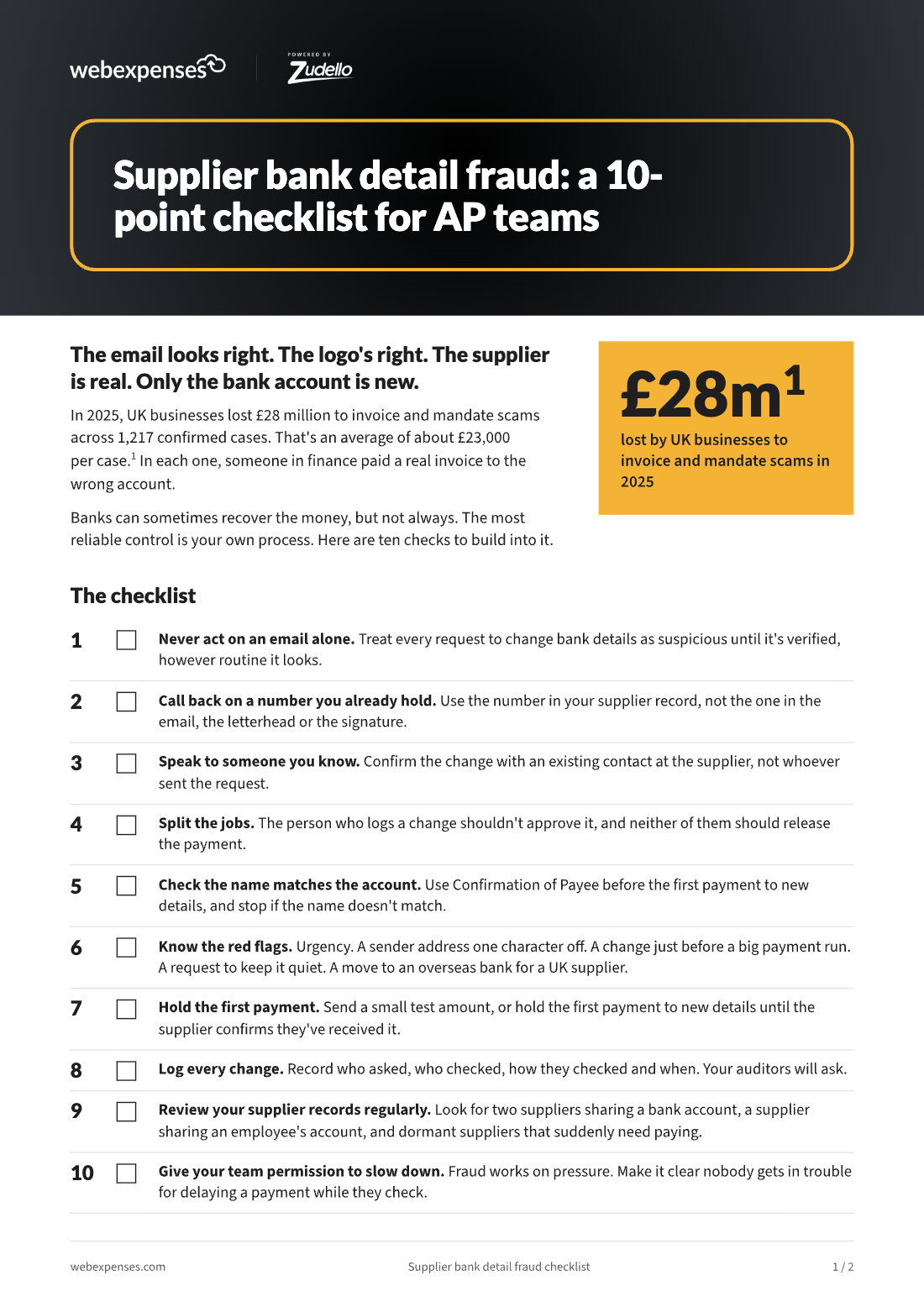
Supplier bank detail fraud: a 10-point checklist for AP teams

The email looks right. The logo’s right. The supplier is real. Only the bank account is new. Ten checks to build into your process before you pay.
2 pages · 10-point checklist · No sign-up needed

At a glance

Verify every change, on a number you already hold

  1. 01£28m lost in 2025. UK businesses lost £28 million to invoice and mandate scams across 1,217 confirmed cases (UK Finance).
  2. 02Never act on an email alone. Call back on a number you already hold, and speak to someone you know.
  3. 03Split the jobs. The person who logs a change shouldn’t approve it, and neither of them should release the payment.

1. Why it matters

In 2025, UK businesses lost £28 million to invoice and mandate scams across 1,217 confirmed cases, an average of about £23,000 per case. In each one, someone in finance paid a real invoice to the wrong account.

£28m lost by UK businesses to invoice and mandate scams in 2025

Source: UK Finance, Annual Fraud Report 2026 (covering 2025), invoice and mandate scams on business accounts. Average per case calculated by Webexpenses.

Banks can sometimes recover the money, but not always. The most reliable control is your own process.

2. The 10-point checklist

  1. Never act on an email alone. Treat every request to change bank details as suspicious until it’s verified.
  2. Call back on a number you already hold. Use the number in your supplier record, not the one in the email.
  3. Speak to someone you know. Confirm with an existing contact at the supplier, not whoever sent the request.
  4. Split the jobs. The person who logs a change shouldn’t approve it, and neither should release the payment.
  5. Check the name matches the account. Use Confirmation of Payee before the first payment, and stop if the name doesn’t match.
  6. Know the red flags. Urgency, a sender address one character off, a change just before a big payment run, a request to keep it quiet.
  7. Hold the first payment. Send a small test amount, or hold the first payment until the supplier confirms receipt.
  8. Log every change. Who asked, who checked, how and when.
  9. Review your supplier records regularly. Look for shared bank accounts and dormant suppliers that suddenly need paying.
  10. Give your team permission to slow down. Fraud works on pressure.

3. Make the checks part of the process

A checklist works when people remember it. Fraudsters time their requests for when they won’t: month-end, holidays, a new starter on the team. The safest checks are built into the workflow, so nobody has to remember them.

Financial Controller? Read the controls a Financial Controller should own.

With Webexpenses Accounts Payable, changes to supplier payment details are approved and checked before they take effect, and every invoice is matched to its order and receipt.

Written for the people who sign it off and the people who make it work

For the decision-maker

Financial Controller, Head of Finance

A clear standard for how bank detail changes are verified. For the controls behind it, see the companion guide for Financial Controllers.

For the team doing the work

AP and supplier management teams

Ten checks to run on every bank detail change request, plus the red flags to watch for.

See it on your own process

Book a discovery call and we’ll talk through how your team works today. Then we’ll tailor a demo to what matters to you.

Platform

FRONT OFFICE

BACK OFFICE

Capabilities

EXPENSES

ACROSS THE PLATFORM

TRUST AND ROADMAP