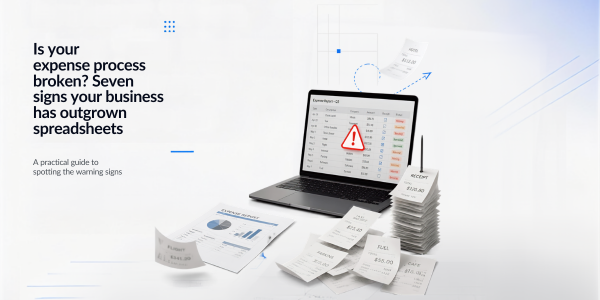
How can you effectively manage something if you can’t clearly see it? This has always been one of the fundamental challenges businesses have faced when trying to control employee expenses reports.
It’s a problem caused by the traditional manual and paper-based methods which companies have used to handle claims, helping to create a kind of organizational ‘fog’ around expenses reports.
The slow and cumbersome processes involved cause an information lag with the only details available being weeks or months out of date. And trying to pull out anything other than the most basic of datasets is a prohibitively time consuming task; reports having to be manually compiled from multiple sources.
But the emergence of digital expense reporting systems is helping to overcome these problems and is giving businesses the ability to start seeing exactly what’s going on within their expenses setup.
A digital system automatically generates a rich source of data on just about every aspect of an expenses regime – from the basic who, what, why and when to details such as the exact route taken for a mileage claim.
Management Vision
This data unlocks a powerful new ability to start using metrics to better manage and monitor expenses reports; using accurate and up-to-date data to understand how a system works and to identify quantifiable ways to improve it.
It’s the business equivalent of the way that technology has transformed motor racing with telemetry data providing support teams with information on every aspect of vehicle performance. These same kind of technologies are now being used to aid coaches throughout the sporting world.
For companies, it allows the setting of trackable goals – whether it’s reducing overall processing times or setting specific targets for individual departments to hit. And for managers, the use of metrics provides an effective way to monitor the effect different decisions have on performance.
Does increasing a particular expense allowance lead to more or less people making claims in that area?
By identifying and tracking just a small number of key expense metrics, a business can start to gain valuable feedback on the success and failure of various management decisions over time.
Data can also be exported into visualization packages to create graphic representations, which can show the workings of an expense system in entirely new ways. It’s a way to highlight patterns and trends which may otherwise have remained hidden in a mass of paperwork.
It allows any early warning signs of future issues to be identified and tackled, rather than having to wait until they reveal themselves as resource-sapping problems. It’s particularly useful for growing companies, helping to identify expense bottlenecks or pressure points as an organisation expands.
If you want to remove the organisational ‘fog’ from your expense management, request a demo of webexpenses by signing up, here.